Ultimate collection of selfies by America’s leading artists:
March 12, 2020
The term self-conscious takes on a whole new meaning in today’s social media era . . . Immerse yourself in the ultimate collection of selfies by America’s leading artists: from 1901 through 2015 . . .
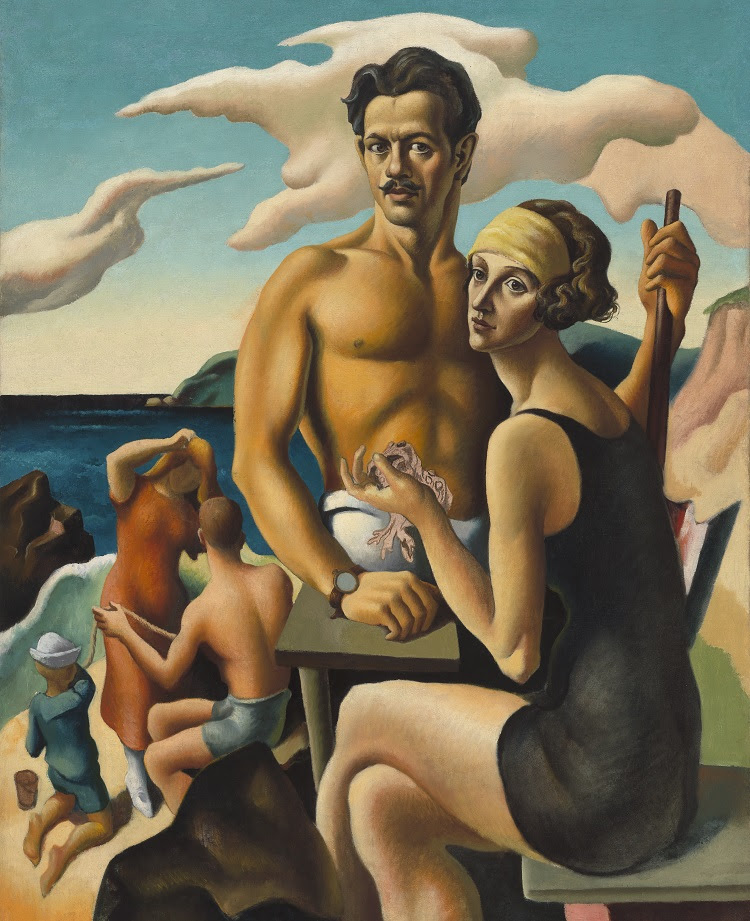
Pictured above — Self-Portrait with Rita, by Thomas Hart Benton. Oil on canvas (c. 1924). National Portrait Gallery, Smithsonian Institution. Gift of Mr. and Mrs. Jack H. Mooney.
At a time when millions of selfies are posted every day and identity becomes more fluid, this impressive collection of self-portraits is spectacular. From every decade of the 20th and 21st centuries (1901 to 2015), by America’s leading artists.
Greetings on behalf of this amazing new show from the Smithsonian National Portrait Gallery, kicking off its national tour on March 24 in South Florida.
Eye to I: Self Portraits from the National Portrait Gallery
Kicks off National Tour in South Florida at the Boca Raton Museum of Art (March 24 – June 14)
The term self-conscious takes on a whole new meaning in today’s social media era. At a time when millions of selfies are posted every day and identity is proving to be more fluid, this exhibition from the Smithsonian’s National Portrait Galleryshines a new light on self-portraiture and representation.
The show was created to commemorate the National Portrait Gallery’s 50th anniversary, celebrating the artists who make the NPG Collection so extraordinary.
Eye to I brings together the work of major artists of the 20th and 21st centuries, and kicks off its national tour at the Boca Raton Museum of Art with an indelible gallery experience sure to fascinate contemporary audiences. The powerful works are from every decade, starting in 1901 and continuing through 2015.
Elaine de Kooning Self-Portrait. Oil on Masonite (1946). National Portrait Gallery, Smithsonian Institution
Immerse Yourself in the Ultimate Collection of “Selfies” by America’s Leading Artists: from 1901 through 2015
The premiere in South Florida of this traveling exhibition is different from the Smithsonian show that was previously on view in Washington, DC – all of the works on paper are new and were chosen especially for the national tour, as are several of the paintings.
“These artists looked inward in ways we can connect with in our modern time. They created a lasting mirror effect for future audiences that most of them could not have foreseen,” said Irvin Lippman, the executive director of the Boca RatonMuseum of Art.
Mirror, Mirror; Mulatta Seeking Inner Negress II by Alison Saar. Woodcut on chine-collé (2015). National Portrait Gallery, Smithsonian Institution
“These artists steered self-portraiture away from the traditional poses of the past into new realms of self-reflection. Their self-depictions cut across time through multiple pathways of creating art that ring true today,” adds Irvin Lippman.
Self-portraits by prominent figures in the history of portraiture include: Robert Arneson, Thomas Hart Benton, Deborah Kass, Elaine de Kooning, Alexander Calder, Jasper Johns, Allan Kaprow, Jacob Lawrence, Louise Nevelson, Irving Penn, Robert Rauschenberg, Fritz Scholder, and Roger Shimomura.
Early works include: Edward Steichen, Edward Hopper, and composer George Gershwin, who was also a painter.
More recent works include: Ana Mendieta, Chuck Close, Lois Dodd, Maria Magdalena Campos-Pons and Alison Saar.
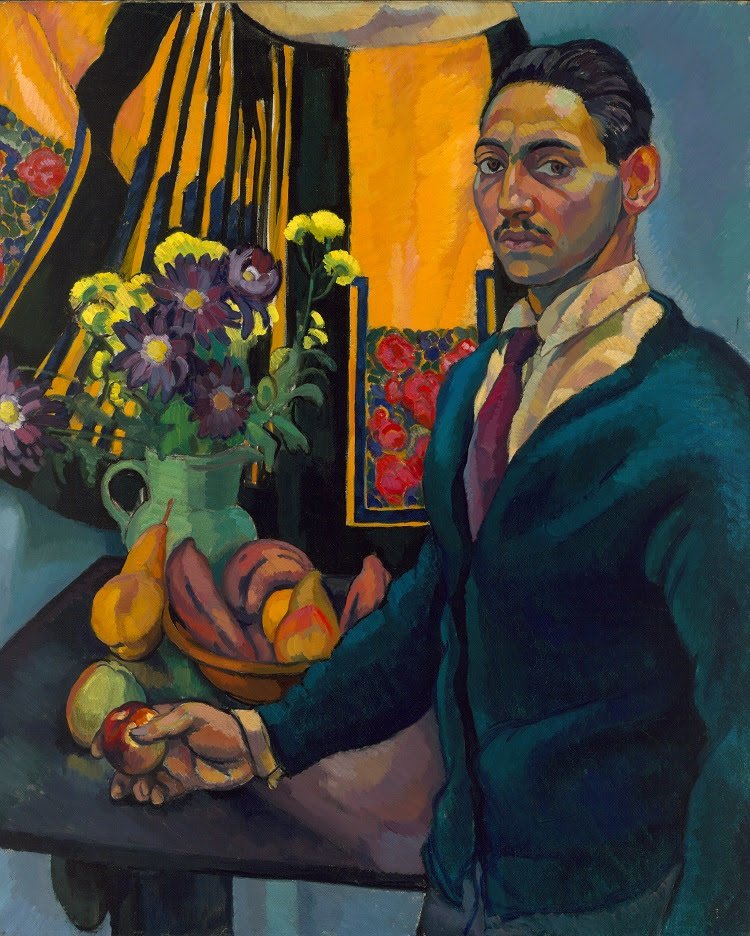
Lee Simonson Self-Portrait. Oil on canvas (c. 1912). National Portrait Gallery, Smithsonian Institution. Gift of Karl and Jody Simonson; Frame conserved with funds from the Smithsonian Women’s Committee
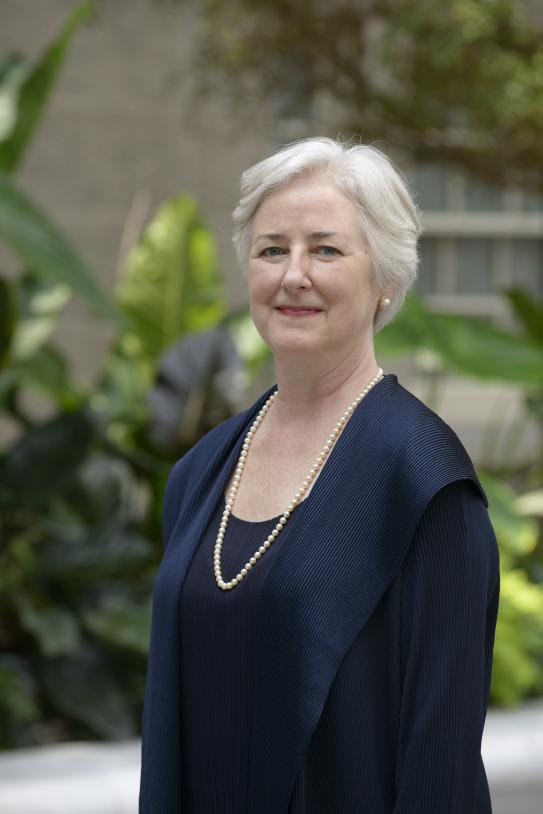
The show was organized by the Chief Curator of the National Portrait Gallery at the Smithsonian, Dr. Brandon Brame Fortune.
She has been invited to South Florida by the Boca Raton Museum of Art to present a special preview lecture on March 24, at 5:30 p.m. Space is limited – RSVP required in advance. Tickets for non-members are $35; free for members.
Eye to I showcases 60 works in a variety of styles and media ranging from caricatures to photographs, from colorful watercolors to dramatic paintings and time-based media.
The exhibition traces the process, from gazing into the mirror to looking into the camera; from painted and drawn surfaces to mechanical reproductions such as prints and photographs; from static forms to video.
Chosen as the cover for the exhibition catalogue, Maria Magdalena Campos-Pons used her own body to map out feelings of translocation from place to place. The bilingual title is in half-Spanish and means When I am not Here, I am There.
She stands with her eyes closed, as though transported between territories while holding on to her Afro-Caribbean talismans.
She stands with her eyes closed, as though transported between territories while holding on to her Afro-Caribbean talismans.
Self-Portrait with Rita, by Thomas Hart Benton. Oil on canvas (c. 1924). National Portrait Gallery, Smithsonian Institution. Gift of Mr. and Mrs. Jack H. Mooney
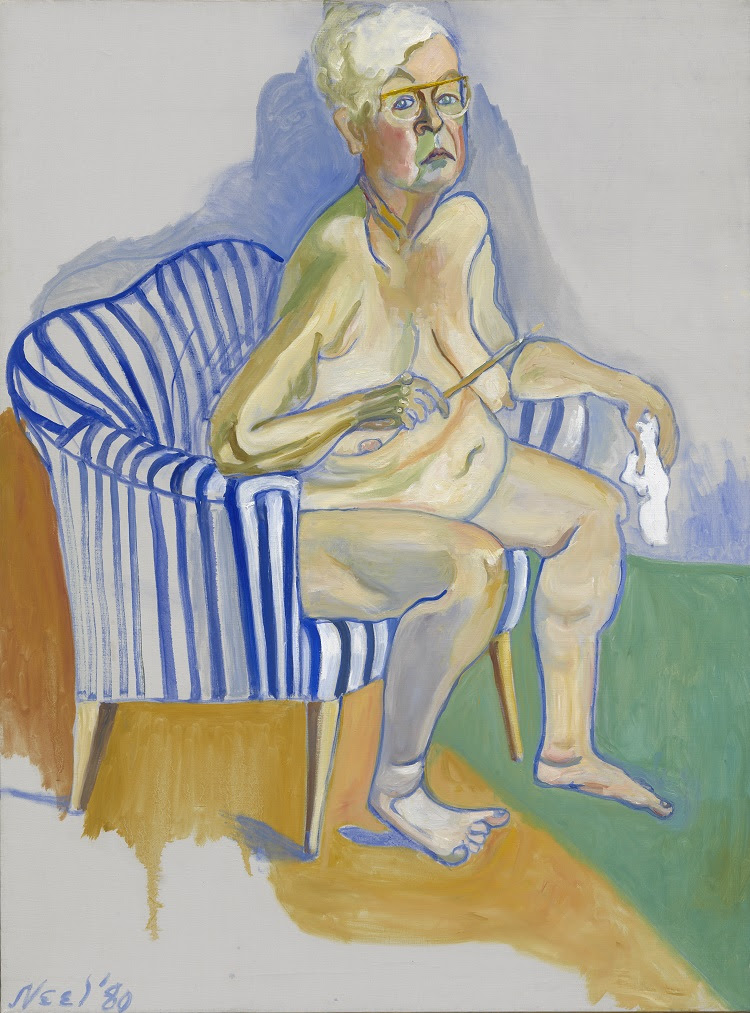
In 1975, Alice Neel began her shocking, endearing, and utterly unconventional self-portrait that took her five years to complete.
She foreshadowed by decades the use of “this is the real me” selfies to challenge gender and body-image stereotypes. Neel took on the history of male artists depicting nude women and flipped it around completely, with absolute control of her image.
An unflinching challenge to the centuries-old convention of idealized femininity, Neel’s self-portrait is openly accepting of her aging body.
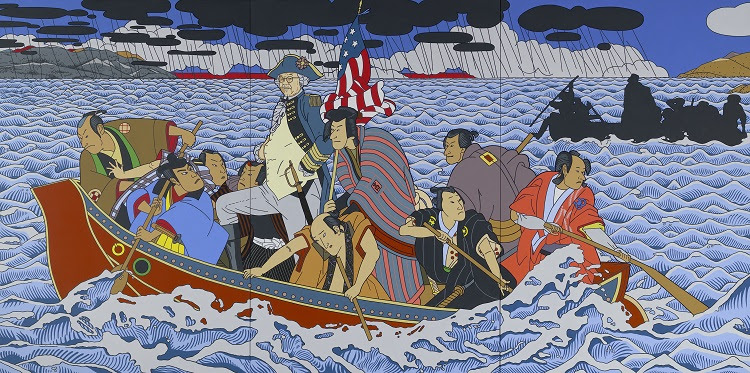
The first thing visitors will see at the Boca Raton Museum of Art is Roger Shimomura’s monumental work, Shimomura Crossing the Delaware. The mammoth painting takes up the entire entry wall.
During World War II, Shimomura and his family were imprisoned at an internment camp, where they became familiar with the widespread xenophobia taking place at that time during the 1940’s.
In the painting, Shimomura cast himself as George Washington and replaced the Revolutionary soldiers with Samurai warriors, while a silhouette of the original painting by Emanuel Leutze haunts the background.
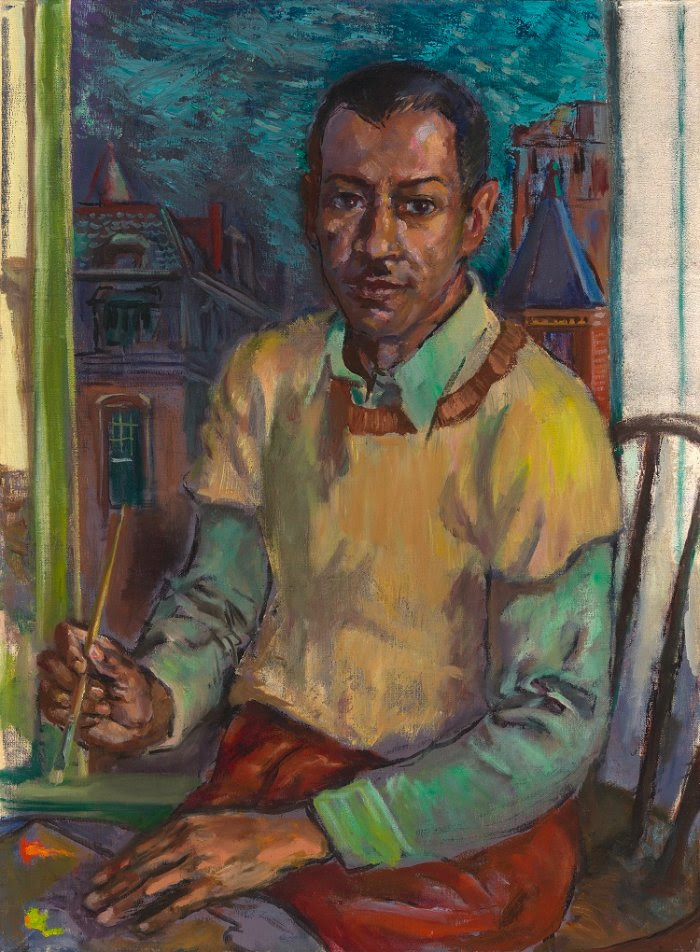
James A. Porter founded the field of African American art history. He chaired Howard University’s Art Department and directed the university’s art gallery from 1953 until his death in 1970.
He studied in France, Cuba, and Haiti and traveled in West Africa, Egypt, and Brazil. These trips abroad impacted his work, including his self- portrait which conveys the influence of Parisian artists.
James Amos Porter Self-Portrait. Oil on canvas (1957). National Portrait Gallery, Smithsonian Institution. Gift of Dorothy Porter Wesley
“These individuals have approached self-portraiture at various points in history and using different tools, but their representations ─ especially when seen together ─ all raise important questions about self-perception and self-reflection,” said Brandon Brame Fortune, chief curator, Smithsonian’s National Portrait Gallery.
“Some artists reveal intimate details of their inner lives through self-portraiture, while others use the genre to obfuscate their private selves or invent alter egos.”
Dr. Brandon Brame Fortune.
The Chief Curator of the National Portrait Gallery, Dr. Brandon Brame Fortune, has been invited to South Florida for a special appearance on March 24 at 5:30, at the Boca Raton Museum of Art. Space is limited – RSVP required in advance. Tickets are $35 (free for members of the Museum).
Eye to I: Self-Portraits from the National Portrait Gallery features a richly illustrated companion volume with an introduction by Brandon Brame Fortune and nearly 150 insightful entries on key self-portraits in the museum’s collection.
The book was published by the National Portrait Gallery in association with Hirmer Publishers, and is distributed by the University of Chicago Press.
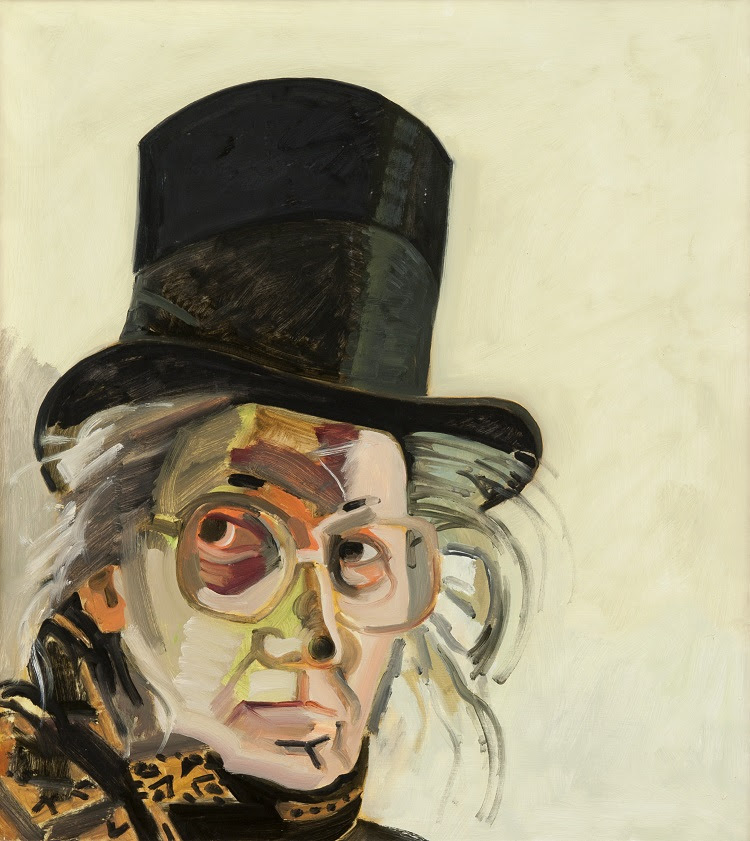
Lois Dodd Self-Portrait. Oil on Masonite (1989). National Portrait Gallery, Smithsonian Institution. Gift of Rebecca Mitchell and Ben Harris.
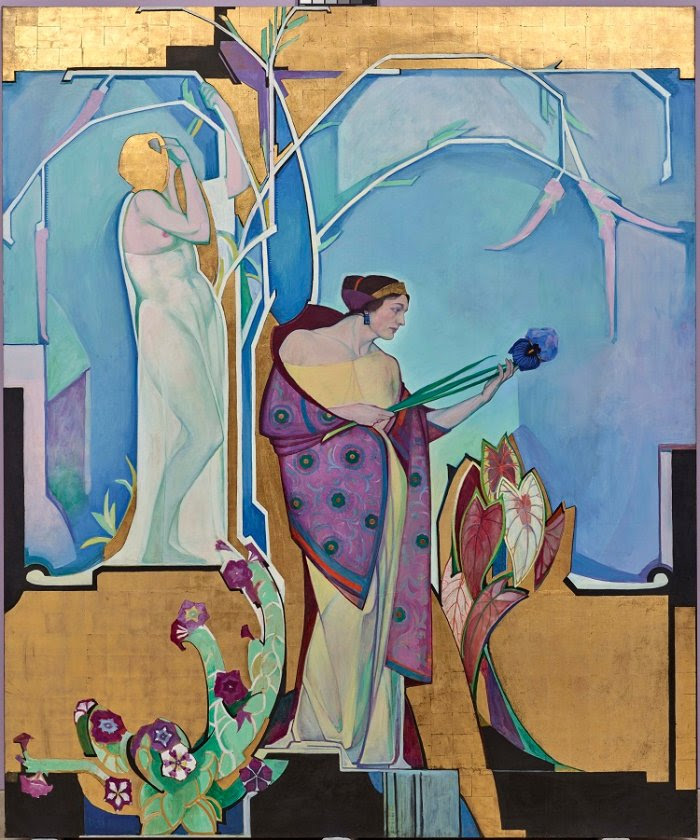
n Exaltation of Flowers: Petunia, Caladium, Budleya, by Edward Jean Steichen Tempera and gold leaf on canvas(c. 1910-1913).
The seven large Art Nouveau panels – ten feet tall each – were painted by Steichen from 1911- 1914 for the Park Avenue townhouse of Eugene Meyer and his wife Agnes but were never installed. After a number of owners, including the Museum of Modern Art, they ended up in the collection of Art Bridges.
The murals are inspired in part by Maurice Maeterlinck’s book, The Intelligence of Flowers, and depict Isadora Duncan, Mercedes de Cordoba, Katharine Rhoades, Marion Beckett and others, along with their floral counterparts.
Celebrating our 70th anniversary in 2020, the Boca Raton Museum of Art encompasses a creative campus that includes the Museum in Mizner Park, Art School, and an Artists Guild. As the “Official Art Museum of the City of Boca Raton,” the Museum has provided seven decades of cultural and artistic service to the community, and to many visitors from around the world. Visit www.bocamuseum.org for more information. For media inquiries, please contact Jose Lima and William Spring, editorial@newstravelsfast.com, 305-910-7762.
ABOUT THE NATIONAL PORTRAIT GALLERY
The Smithsonian’s National Portrait Gallery tells the multifaceted story of the United States through the individuals who have shaped American culture. Spanning the visual arts, performing arts and new media, the Portrait Gallery portrays poets and presidents, visionaries and villains, actors and activists, whose lives tell the American story.
The National Portrait Gallery is part of the Donald W. Reynolds Center for American Art and Portraiture at Eighth and F Streets NW, Washington, DC. Smithsonian information: (202) 633-1000. Connect with the museum at npg.si.edu, Facebook, Instagram, Twitter, and YouTube.
Thank you,
Glenda, Charlie and David Cates
Cookie Consent
We use cookies to improve your experience on our site. By using our site, you consent to cookies.
Contains information related to marketing campaigns of the user. These are shared with Google AdWords / Google Ads when the Google Ads and Google Analytics accounts are linked together.
90 days
__utma
ID used to identify users and sessions
2 years after last activity
__utmt
Used to monitor number of Google Analytics server requests
10 minutes
__utmb
Used to distinguish new sessions and visits. This cookie is set when the GA.js javascript library is loaded and there is no existing __utmb cookie. The cookie is updated every time data is sent to the Google Analytics server.
30 minutes after last activity
__utmc
Used only with old Urchin versions of Google Analytics and not with GA.js. Was used to distinguish between new sessions and visits at the end of a session.
End of session (browser)
__utmz
Contains information about the traffic source or campaign that directed user to the website. The cookie is set when the GA.js javascript is loaded and updated when data is sent to the Google Anaytics server
6 months after last activity
__utmv
Contains custom information set by the web developer via the _setCustomVar method in Google Analytics. This cookie is updated every time new data is sent to the Google Analytics server.
2 years after last activity
__utmx
Used to determine whether a user is included in an A / B or Multivariate test.
18 months
_ga
ID used to identify users
2 years
_gali
Used by Google Analytics to determine which links on a page are being clicked
30 seconds
_ga_
ID used to identify users
2 years
_gid
ID used to identify users for 24 hours after last activity
24 hours
_gat
Used to monitor number of Google Analytics server requests when using Google Tag Manager
1 minute
Marketing cookies are used to follow visitors to websites. The intention is to show ads that are relevant and engaging to the individual user.
HubSpot is an all-in-one marketing, sales, and customer service platform that streamlines business growth.
This cookie allows the user to access the app with the correct permissions.
7 days
hubspotapi-prefs
This is used with the hubspotapi cookie to remember whether the user checked the 'remember me' box (controls the expiration of the main cookie's authentication).
1 Year
__hs_opt_out
This cookie is used by the opt-in privacy policy to remember not to ask the visitor to accept cookies again.
13 months
hubspotapi-csrf
This is used for CSRF prevention - preventing third party websites from accessing your data. Expires after a year.
1 year
__hs_do_not_track
This cookie can be set to prevent the tracking code from sending any information to HubSpot.
13 months
__hs_cookie_cat_pref
This cookie is used to record the categories a visitor consented to.
6 months
__hs_initial_opt_in
This cookie is used to prevent the banner from always displaying when visitors are browsing in strict mode.
7 days
__hs_gpc_banner_dismiss
This cookie is used when the Global Privacy Control banner is dismissed.
180 days
hs_ab_test
This cookie is used to consistently serve visitors the same version of an A/B test page they’ve seen before.
session
__hs_notify_banner_dismiss
This cookie is used when the website uses a Notify consent banner type.
180 days
hs-messages-is-open
This cookie is used to determine and save whether the chat widget is open for future visits.
30 minutes
hs-messages-hide-welcome-message
This cookie is used to prevent the chat widget welcome message from appearing again for one day after it is dismissed.
1 day
__hsmem
This cookie is set when visitors log in to a HubSpot-hosted site.
1 year
hs-membership-csrf
This cookie is used to ensure that content membership logins cannot be forged.
session
hs_langswitcher_choice
This cookie is used to save the visitor's selected language choice when viewing pages in multiple languages.
2 years
__hstc
The main cookie for tracking visitors.
13 months
hubspotutk
This cookie keeps track of a visitor's identity. It is passed to HubSpot on form submission and used when deduplicating contacts.
13 months
__hssc
This cookie keeps track of sessions.
30 minutes
__hssrc
Whenever HubSpot changes the session cookie, this cookie is also set to determine if the visitor has restarted their browser.
session
messagesUtk
This cookie is used to recognize visitors who chat with you via the chatflows tool. If the visitor leaves your site before they're added as a contact, they will have this cookie associated with their browser.
13 months
You can find more information in our Cookie Policy and .