Content note: This article discusses childhood sexual abuse, including abuse involving siblings, threats, and the long-term effects of trauma. Please read with care.
As a mother who raised Suzzane and Charlie and spent years homeschooling, I’ve always believed that one of the most important things we can give our children is the knowledge that they can come to us when something is wrong. We teach our children to look both ways before crossing the street. We remind them not to go anywhere with strangers. We talk about bullying, friendships, and making good choices.
But sometimes the conversations we most need to have are the ones that make us uncomfortable. What happens when the person hurting a child isn’t a stranger? What happens when that person is someone the child knows, loves, or has been taught to trust? And what happens when a child is frightened into believing that speaking up will destroy the family they love?
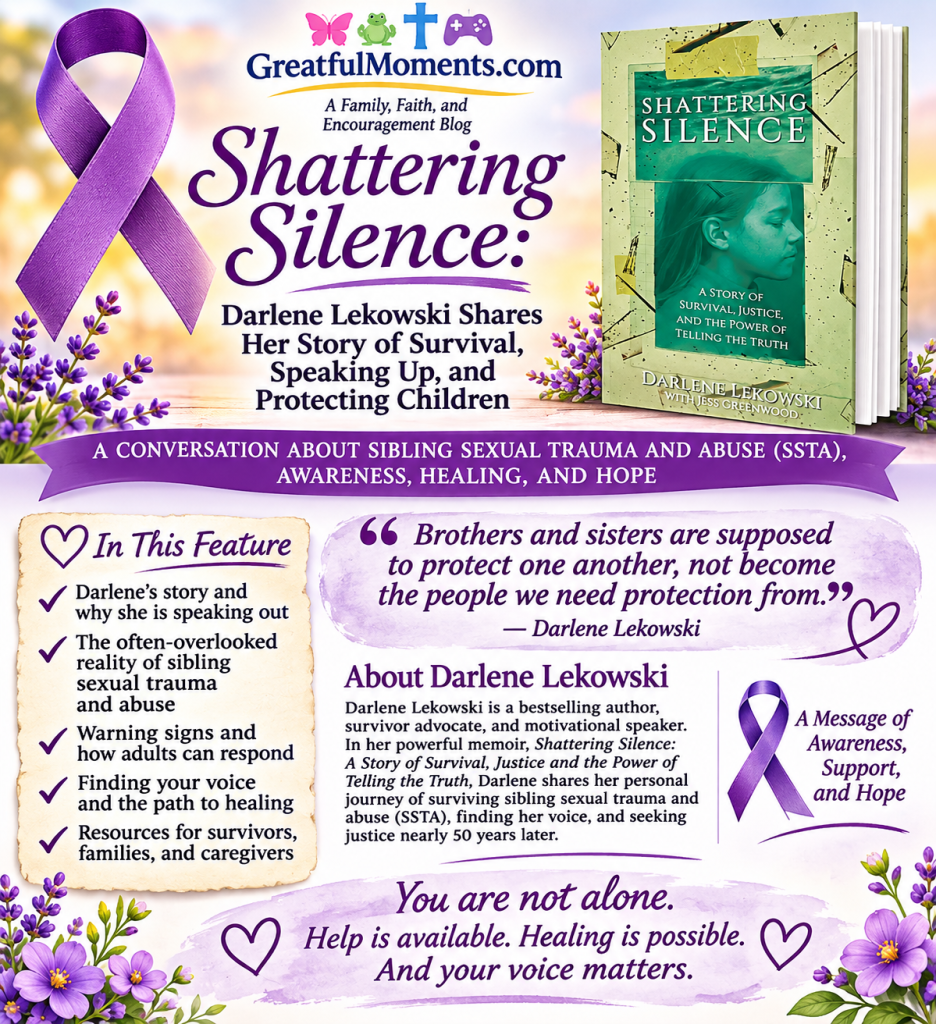
Those are difficult questions, but avoiding them doesn’t make children safer. When I had the opportunity to interview bestselling author and survivor advocate Darlene Lekowski, I knew her story was one our readers needed to hear. Darlene is the author of Shattering Silence: A Story of Survival, Justice and the Power of Telling the Truth. Her memoir and advocacy focus on sibling sexual trauma and abuse, often abbreviated as SSTA.
Before reading her answers, I want to make something clear: This article isn’t about blaming every family or teaching children to be afraid of everyone around them. It’s about recognizing that abuse can happen in places where we least expect it, listening when children need us, and understanding that a family looking happy from the outside doesn’t tell us everything happening behind closed doors. As parents, grandparents, caregivers, and homeschool families, we have a responsibility to make sure children know they can speak up. And when they do, we need to listen.
Meet Darlene Lekowski: The Woman Behind Shattering Silence
Darlene Lekowski is a bestselling author, motivational speaker, and survivor advocate whose work focuses on helping people understand sibling sexual trauma and abuse. Darlene grew up in a family that appeared successful and loving from the outside. Her father was a business executive, her mother owned a Christian bookstore, and she participated in school activities and athletics. But Darlene says that between the ages of seven and twelve, she experienced sexual abuse by her two oldest brothers.
For nearly five decades, she carried that experience privately. She went on to build a successful 40-year career in financial technology. To people looking at her life from the outside, she appeared to be thriving. Yet the experiences of her childhood continued to affect her sense of safety, her relationships, and the way she approached life.
In 2021, Darlene confronted one of her brothers. She recounts that he subsequently sued her for defamation, that she countersued, and that a jury found in her favor on February 5, 2024. Today, Darlene shares her experiences through public speaking, advocacy, and her memoir, Shattering Silence: A Story of Survival, Justice and the Power of Telling the Truth.
Her story reminds us that someone can appear successful, happy, and confident while carrying pain that others know nothing about. I appreciate Darlene’s willingness to answer our questions about this difficult subject. The following interview is presented in her own words.
Our Interview with Darlene Lekowski
1. Many people associate domestic violence primarily with intimate partners. What would you like readers to understand about sibling sexual trauma and abuse (SSTA), and why is it so often overlooked?
When we think about domestic violence, we often picture abuse between intimate partners. But sexual abuse can also happen between siblings, behind the closed doors of homes that appear perfectly normal to the outside world. I know because I lived it.
From the ages of seven to twelve, I was sexually abused by my two oldest brothers. I grew up in what appeared to be a picture-perfect, upper-middle-class ‘country club’ family. My dad was a top executive at the largest company in town and my mom owned only Christian Bookstore in the entire area. SSTA can happen anywhere to anyone in any family. It has no boundaries.
I was the youngest of five children – two girls and three boys. We had a beautiful home, loving parents, and everything that should have made a little girl feel safe. But I wasn’t safe because of my two oldest brothers.
What makes SSTA especially troubling is how common researchers and advocates believe it may be—and how rarely we talk about it. Sibling sexual trauma and abuse is described in the research literature as one of the most common forms of intrafamilial child sexual abuse, yet it remains deeply underrecognized. 5WAVES shares research and educational materials that help put its prevalence in perspective, including the striking comparison that a classroom of 25 children may likely include at least one child impacted by SSTA. These are estimates, not a way to identify individual children, but they should challenge the assumption that this is rare.
SSTA is often overlooked because society struggles to recognize that children can sexually harm other children, particularly within the same family. Harmful behavior may be dismissed as curiosity, experimentation, or simply “kids being kids.” Parents may miss the warning signs, and families may be reluctant to confront something that threatens everything they believe about their family. But coercive or abusive sexual behavior is not harmless childhood experimentation. It can have devastating, lifelong consequences.
I want people to understand that brothers and sisters are supposed to protect one another, not become the people we need protection from. And just because abuse happens inside a family doesn’t make it any less real, damaging, or deserving of accountability.
2. How can secrecy, shame, and fear affect a survivor’s ability to speak about childhood abuse, particularly when the person who caused the harm is a family member?
Secrecy, shame, and fear can become a prison that survivors carry for decades. When I was a little girl, I was threatened into silence. I was told no one would believe me, that I was dirty, and that telling would destroy my family and could even kill my parents. Imagine putting that responsibility on a seven-year-old child.
But you need to know that 90% of my life was good. It was beautiful. It was just the 10% that was poisoned. I didn’t want to give that life up. I didn’t want to lose my family. I didn’t want to become an orphan as those brothers told me would happen. At nine years old, I made a critical decision that would shape the next 50 years of my life. I said to myself: “You can steal my childhood and take away my innocence. But you will never ever take my family from me!”
So, I stayed silent. Not because what happened wasn’t serious. Not because I wasn’t suffering. But because I believed keeping that secret was the only way to protect the family and life I loved. Silence doesn’t mean the abuse stops affecting you. It means you learn how to live around it.
I became an overachiever, a perfectionist, and someone who needed to control everything. I built a successful 40-year career in financial technology. From the outside, I looked like success. But underneath that success was a little girl who had learned that control meant safety and winning meant survival.
When I finally confronted one of my brothers in 2021, nearly 50 years later, he sued me for defamation. I countersued, and on February 5, 2024, a jury unanimously found in my favor. The very person who silenced me as a child tried to silence me again as an adult. That’s why we must stop asking survivors, “Why didn’t you tell someone sooner?” and start asking, “What made it so difficult for you to tell?”
3. What are some signs that a child may be experiencing harmful or inappropriate behavior from a sibling, and how can adults respond in a way that prioritizes the child’s safety?
One of the most important things parents and caregivers need to understand is that children don’t always have the words to explain what is happening to them. And sometimes, like me, they’ve been threatened into silence.
Warning signs may include sudden behavioral changes, nightmares, anxiety, withdrawal, fear of being alone with a particular sibling, age-inappropriate sexual knowledge or behavior, or unexplained changes in school performance.
But here’s something I especially want parents to hear: Not every child who is being abused shows obvious signs. I was an excellent student, an athlete, a cheerleader, and involved in student government. I was the child who appeared to be thriving. I learned to hide what was happening by becoming everything everyone expected me to be.
That’s why adults cannot rely solely on outward behavior to determine whether a child is safe. Talk openly with all your children, in age-appropriate language, about body boundaries, consent, and the fact that no one—including a sibling, parent, teacher, or counselor—has the right to touch their private parts or ask them to keep unsafe touching secret. Explain that they can always tell a trusted adult, even if someone threatens them or says they will get in trouble. Necessary caregiving or medical care should be explained, appropriate, and never secret. I sometimes wonder whether I might have felt safer disclosing what was happening if my parents had started conversations like these. Maybe I wouldn’t have waited nearly 50 years to tell my story.
If a child discloses inappropriate sexual behavior, believe them, remain calm, thank them for telling you, and make it clear that what happened is not their fault. Don’t interrogate them or pressure them for details. Ensure they are safe and seek guidance from qualified child protection professionals.
And please, don’t dismiss harmful sexual behavior between siblings as normal curiosity or something children will simply outgrow. Age, developmental differences, coercion, secrecy, threats, and power imbalances matter. Protecting a child’s safety must always take priority over protecting a family’s reputation.
4. For survivors who have carried these experiences into adulthood, what would you want them to know about finding support and beginning to speak about what happened?
First, I want every survivor to know something I wish I had understood much earlier: What happened to you does not define who you are. And it’s never too late to tell your story.
For nearly 50 years, I carried a secret that influenced how I saw myself, how I approached relationships, and how I navigated my career. I didn’t understand how much of my adult life was being driven by the survival instincts of a little girl. I eventually learned that surviving and healing are two very different things.
My healing journey has included therapy, trauma-focused treatment, and learning to recognize the ways my childhood experiences shaped my need for control. It hasn’t been easy, and healing isn’t a straight line.
But I also learned that telling the truth doesn’t mean you have to tell the entire world. You can begin with one trusted person, a therapist, or a survivor support organization. You get to decide when, how, and with whom you share your story.
I often describe trauma as a box we carry through life. We put painful experiences inside, close the lid, and convince ourselves we’ve moved on. But those experiences don’t simply disappear. They can influence our decisions, relationships, and behaviors without our even realizing it. You cannot change what happened to you. But you can change how much power it continues to have over your life.
Today, at 60 years old, I’m sharing my story publicly, speaking to audiences across the country, and advocating for laws that protect survivors from retaliatory defamation lawsuits. I never imagined that the secret I carried for nearly five decades would eventually become the foundation of my life’s purpose. My message to survivors is simple: You are not what happened to you. You are who you choose to become. And it is never too late to begin living forward.
5. What resources or next steps would you recommend to someone who recognizes these experiences in their own family or is concerned about a child who may be at risk?
The first step is to take the concern seriously. Don’t dismiss it, minimize it, or assume that because the children are siblings, the behavior cannot be abusive.
If a child may be at risk, prioritize their immediate safety. Prevent further unsupervised contact where necessary, listen without judgment, and seek guidance from trained child protection professionals. If abuse is suspected, contact the appropriate child protective services agency or law enforcement. You do not need to conduct your own investigation before asking for help.
For adult survivors, I encourage finding a trauma-informed therapist or support organization familiar with childhood sexual abuse, particularly sibling sexual trauma and abuse (SSTA). You don’t have to navigate the healing process alone, and you don’t have to share your story publicly to begin reclaiming your life.
Organizations I recommend include 5WAVES, IncestAWARE, and SSTA Aware, all important voices in increasing awareness of sibling sexual trauma and abuse. Additional support and child protection resources include RAINN, Stop It Now!, the National Children’s Alliance, and Childhelp.
I also share my experiences, advocacy work, and resources at DarleneSpeaksUp.com, including a dedicated Resources page for SSTA and other survivors, and in my memoir, Shattering Silence: A Story of Survival, Justice and the Power of Telling the Truth.
If there is one thing I want families to remember, it’s this: Silence protects the abuse, not the child. And to every survivor who may be reading this: No one can touch who you truly are. Your voice matters. Your story matters. And there is life beyond what happened to you.
After reading Darlene’s answers, I kept thinking about how important it is for children to have adults they can trust. As parents, we can’t always know everything happening in our children’s lives. But we can make sure they know we’re willing to listen. We can teach them that their bodies deserve respect, that unsafe secrets should never be kept, and that they can come to us even when they’re scared.
And if a child does tell us something difficult, our first responsibility is to protect that child, not worry about how the situation might make the family look. I also want to acknowledge the adults reading this who may recognize parts of their own childhood in Darlene’s story.
You don’t have to share your experiences publicly to deserve support. You can seek help privately, at your own pace, from someone qualified to listen. One thing I appreciate about Darlene’s interview is that she reminds us healing doesn’t follow a schedule. Some people speak up when they’re young. Others need years or even decades before they feel ready.
What matters is that survivors have the opportunity to be heard and supported. Darlene’s willingness to share her story also reminds me why we need to have difficult conversations with our children. Whether we’re homeschooling, raising children who attend public school, or helping care for our grandchildren, their safety matters more than our discomfort.
Children deserve to feel safe. Survivors deserve to be heard. And families deserve access to information that can help them recognize and respond to abuse. Thank you, Darlene, for trusting us with your story and for helping bring attention to a subject that too often remains hidden. May your words encourage families to listen more closely, ask important questions, and protect the children entrusted to their care.
Resources for Families and Survivors
If you are concerned about a child or need support, the following organizations offer information and assistance:
- 5WAVES: Education and resources concerning sibling sexual trauma and abuse.
- RAINN: Sexual assault support and information. National Sexual Assault Hotline: 800-656-HOPE (4673).
- Stop It Now!: Prevention resources for adults concerned about harmful sexual behavior involving children.
- National Children’s Alliance: Information about Children’s Advocacy Centers and coordinated child protection responses.
- Childhelp: National Child Abuse Hotline: 800-422-4453.
- Darlene’s Resources Page: Additional information and organizations, including resources focused on sibling sexual trauma and abuse.
If a child is in immediate danger, contact emergency services. For suspected child abuse, seek guidance from local child protective services or law enforcement.
Shattering Silence: A Story of Survival, Justice and the Power of Telling the Truth By Darlene Lekowski
Darlene’s bestselling memoir explores her experiences, the impact of childhood trauma, her pursuit of justice, and her decision to speak publicly. The book is available in paperback, hardcover, ebook, and audiobook formats.
Learn more about Darlene Lekowski:
Editor’s note: Darlene’s interview responses have been preserved from the material provided for publication. Her personal experiences, legal account, and research estimates are presented as her statements and have not been independently verified by GreatfulMoments.com.
GratefulMoments.com
Grateful. Thankful. Blessed.
Thank you,
Glenda, Charlie and David Cates