Inside this post is my affiliate link. If you click on the link and make a purchase I will make a small percentage from the products you purchase.
Brought to you by Christine Miles by Official website: https://www.christinemileslistens.com
Before we get started, I’d like to share something special with you! Author Christine Miles was gracious enough to take time out of her busy schedule to visit our virtual front porch and share her thoughts with our GreatfulMoments.com family. Christine is an author and listening expert who believes that learning to truly listen can change the way we communicate with our children, spouses, friends, and even the people we work with. I don’t know about you but I believe that in so many ways.
Toward the end of this article, you’ll have the opportunity to get to know Christine through a special 12-question interview. She shares her thoughts on listening, family relationships, setting boundaries, dealing with grief, and making meaningful memories during Thanksgiving and Christmas.
I hope you enjoy getting to know Christine and learning about her books! And as always, if you have thoughts, questions, or experiences you’d like to share, please leave us a comment. We love hearing from our readers! Now, let’s talk about two books we’re excited to introduce as we continue Helping Santa Load the Sleigh!
As a parent, one thing that has always been very important to me is encouraging our children to sit down, pick up a book, and read. Which is why I created the 10 Minute Reading Challenge. When Suzanne and Charlie were growing up, I wanted them to understand that reading wasn’t just something we did because a teacher assigned it or because it was part of our homeschool lessons.
Reading could take us on adventures, introduce us to new people, help us understand the world, and teach us lessons that would stay with us long after we closed the book. And that’s something I still believe today. That is why I shared our Ten-Minute Reading & Activity Tickets Challenge with my readers to encourage families to make reading part of their everyday routines.
Sometimes all it takes is ten minutes. Ten minutes before bedtime. Ten minutes after lunch. Or ten minutes sitting together on the couch with a favorite book. Those little moments add up, and before you know it, you’re creating memories your children may carry with them for the rest of their lives.
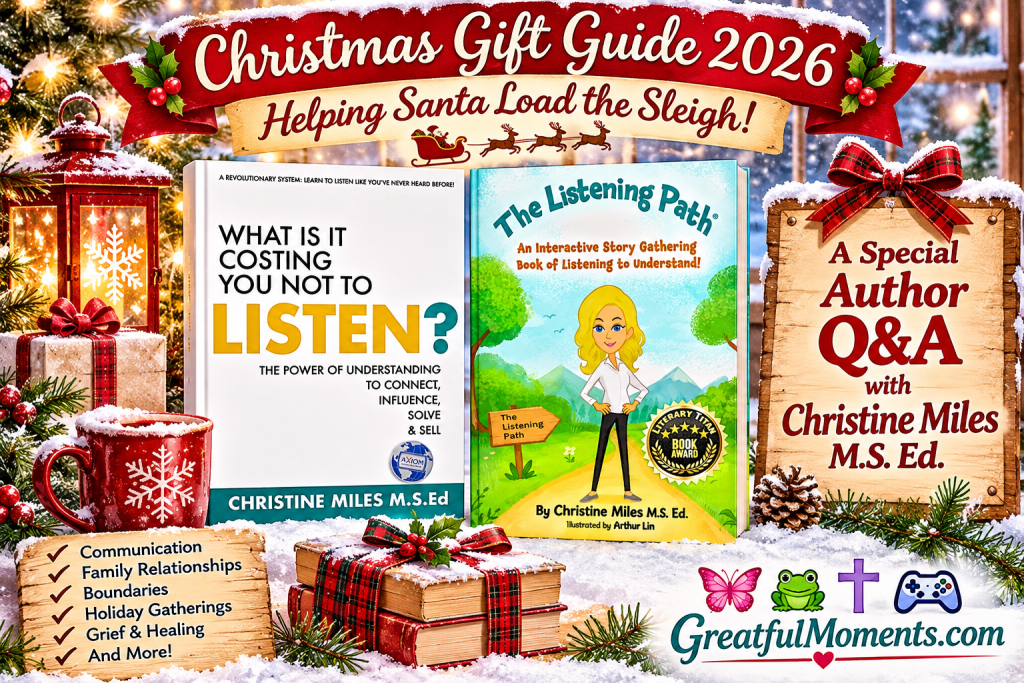
This week, I’d like to introduce you to a new author we’re welcoming to GreatfulMoments.com, Christine Miles. Christine has a children’s book and a book for adults we’re excited to include in our 2026 Christmas Gift Guide, and I think both offer something special for families.
The first book is What Is It Costing You Not to Listen?: The Power of Understanding to Connect, Influence, Solve & Sell. This is definitely a book I can’t wait to sit down and read. Why? Because if I’m being truthful, listening is something I sometimes struggle with.
Not only as a parent, but as a wife and business owner, too. Sometimes we’re so busy thinking about what we’re going to say next that we forget to stop and really hear what the other person is trying to tell us. I know there have been times when David or Charlie was talking to me and I was already thinking about the next thing I needed to do.
And when you’re running a website, working with businesses, answering emails, and taking care of your family, it’s easy to become distracted. But that doesn’t mean we shouldn’t work on doing better. That’s why Christine’s message caught my attention. I want to become a better listener, not just for myself but for the people I love. And I believe this book could be a thoughtful Christmas gift for parents, spouses, business owners, teachers, and anyone who wants to strengthen their relationships.
The second book is The Listening Path: An Interactive Story-Gathering Book of Listening to Understand. This book is designed for children ages three to ten, and I absolutely love the idea behind it! You know how much I enjoy anything interactive so this would be a great book for my nieces and nephews.
When children can participate in a story instead of simply sitting and listening, it gives them another opportunity to learn, ask questions, and become involved in what they’re reading. According to Christine, this book encourages children and adults to take turns gathering each other’s stories and then telling those stories back.
What a wonderful way to teach children that listening is more than simply being quiet while someone else talks! It’s about understanding what another person is trying to share. And I can already see how this could become part of a homeschool lesson. Can’t you?
For families participating in our Ten-Minute Reading & Activity Tickets Challenge, I think The Listening Path could offer a meaningful reading activity. Here’s an idea I would love for families to try:
Our Ten-Minute Family Listening Challenge
- Minutes 1–3: Sit down together and read part of the book.
- Minutes 4–6: Let your child share a story about something that happened during the day.
- Minutes 7–8: Repeat what you heard in your own words and ask whether you understood correctly.
- Minutes 9–10: Switch places and let your child listen to one of your stories.
Afterward, talk about how it felt to have someone really listen. This is an activity idea inspired by Christine’s approach, rather than an exercise we’ve personally completed from the book. For homeschool families, it could open the door to lessons about reading comprehension, communication, kindness, patience, and respect. And teachers might enjoy incorporating a similar activity into their classrooms.
Speaking of teachers, I want to remind parents and grandparents about something as they’re shopping for Christmas gifts this year. Don’t forget the teachers! I know coffee gift cards are popular, and there’s certainly nothing wrong with treating a teacher to a cup of coffee. But I also believe a thoughtfully chosen book can go a lot further. Think about it.
A teacher might enjoy that coffee for a few minutes, but a book that can be shared with an entire classroom has the potential to reach child after child, year after year. And what better gift could we give than helping children learn to listen, understand one another, and communicate with kindness? We’re looking forward to receiving our books and spending time reading them.
In the meantime, I wanted to introduce Christine and her work in case you’re making your Christmas wish list, shopping for a teacher, or looking for something meaningful to add to Santa’s sleigh.
Her Thoughts: Meet Christine Miles
One of my favorite parts of GreatfulMoments.com is getting to know the people behind the books and products we share. Sometimes an author’s story is just as meaningful as the book they’ve written. And Christine Miles has a story worth hearing. Christine is the founder and CEO of EQuipt, an author, professional speaker, consultant, executive coach, and expert in listening and communication.
With a background in psychology and more than 25 years of experience working with individuals and organizations, Christine has dedicated much of her career to helping people understand the importance of listening. Her work focuses on emotional intelligence, communication, relationships, and understanding others. But her interest in listening began long before she started her professional career.
As a little girl, Christine learned about the importance of listening through her relationship with her mother, who experienced depression, anxiety, and the lifelong pain of losing her own mother as an infant. Christine began recognizing that people sometimes try to comfort someone without truly understanding what that person is feeling.
That realization eventually helped shape what she calls the Listening Gap. It’s the difference between the story someone is actually living and the story another person hears or understands. Through EQuipt, Christine works to help people close that gap. She believes listening is a skill that can be learned and taught, rather than something we should simply expect people to know how to do.
Her book What Is It Costing You Not to Listen? explores how listening affects communication, leadership, relationships, and business. Her children’s book, The Listening Path, brings those same principles into the home through an interactive experience for children and the adults who love them.
What especially caught my attention was Christine’s belief that listening begins at the kitchen table. As a mom, that really speaks to me. Our kitchen tables are where we share meals, discuss our days, make plans, celebrate accomplishments, and sometimes work through disagreements.
And during Thanksgiving and Christmas, those conversations can become even more meaningful. But as we all know, holiday gatherings aren’t always picture-perfect. Sometimes families are dealing with disagreements, complicated relationships, grief, or expectations that can make the season difficult. That’s why I was grateful when Christine agreed to answer our questions.
A Special Interview With Christine Miles: Listening, Family Relationships, and the Holidays– Christine graciously answered 12 questions for our GreatfulMoments.com readers. We’re sharing her responses in her own words.
1. What inspired you to focus on listening and communication, and how did that journey lead to your books?
Christine Miles:– It started at my mother’s kitchen table. My mother lived with depression and anxiety, and she carried a lifelong ache from losing her own mother three months after she was born. As a little girl, I learned to listen to what she said and what she didn’t. When she opened up about growing up without a mom, people rushed in to cheer her up: “Look at all the good things in your life.” They meant well, but every time, I watched her pain get worse.
Years later, I gave that a name: the Listening Gap, the distance between the story someone is living and the story we actually hear and understand. As a family therapist and later a consultant to organizations, I saw that gap everywhere.
I created The Listening Path, a path to understanding, to close it. What Is It Costing You Not to Listen? brings the path to leaders. The Listening Path: An Interactive Story-Gathering Book of Listening to Understand brings it home to children ages 3 to 10 and the adults who love them. Parent and child take turns gathering each other’s stories, then telling them back, so children learn listening by doing it.
2. Why do you believe the traditional advice to simply keep the peace can sometimes make holiday gatherings more difficult?
Christine Miles:– Keeping the peace usually means keeping quiet. We smile, change the subject, and swallow what we really feel. Dinner goes fine on the surface, but the frustration and hurt is still there, and it tends to leak out later in a sharp comment or a slammed car door on the way home.
Peace that depends on silence isn’t really peace. It’s tension hiding below the surface, and it widens the gap between what is said and what is understood. What actually lowers the tension is understanding. You don’t have to have every hard conversation at the table, but pretending nothing is wrong rarely makes the holidays easier.
3. How can families establish boundaries without creating additional arguments?
Christine Miles:– Listen before you set the boundary. Most arguments start because someone feels dismissed. If you start by understanding the other person, the boundary lands much more softly.
Say your mother wants everyone at her house for three days and you can only manage one. Ask her first: “Tell me what this year means to you.” Then tell her what you heard: “It sounds like having everyone together feels especially important since Dad’s been sick.” Once she feels understood, share your limit kindly: “We can’t do three days this year, but we’d love to be there all day Christmas Eve.” You’re still holding the line, just with more warmth.
4. What should a parent do when a relative criticizes their parenting choices in front of their children?
Christine Miles:– Keep it short in the moment. Your children are watching how you handle it, and that matters more than winning the point. A simple “Thanks, we’ve got it” is enough.
Later, find a private moment with that relative and get curious: “Earlier you said something about bedtime. Tell me more about what worried you.” There’s often a story underneath, like a fear for the child or a memory of how they raised their own kids. You may still disagree, but understanding makes the next conversation easier.
Then check in with your kids: “How did that make you feel when Grandma said that?” Children often take criticism of their parents personally, and they need a chance to tell their side too.
5. How can grandparents, parents, and adult children handle disagreements without allowing them to ruin Thanksgiving or Christmas?
Christine Miles:– You don’t have to agree with someone to understand them. The challenge is that our brain is the greatest enemy of listening. We hear family through years of history, assumptions, and what we’re planning to say back. That filter contaminates what we hear, so good listening means clearing it to hear the real story.
In the book, I use five questions I call the Compass: “Take me back to the beginning,” “Then what happened?” “How did that make you feel?” “Tell me more,” and “It sounds like you felt…”
Say Grandpa announces, “Kids today have it way too easy.” Instead of rolling your eyes, ask, “Take me back to the beginning. How did you come to see it that way?” He might tell you he started working at fourteen to help support his family. Then use what I call the Flashlight to shine a light by telling his story back: “let me see if I get you, so you had to grow up fast, and you worry kids today won’t be ready for how hard life can be?” The temperature drops quickly when someone feels understood.
6. What advice would you give a family spending its first holiday together after losing a loved one?
Christine Miles:– Don’t pretend the chair isn’t empty. Families often avoid mentioning the person they lost for fear of making everyone sad. But the sadness is already there, and avoiding it can leave people feeling alone with their grief.
Make space for stories. Ask, “What’s a favorite holiday memory you have of Grandpa?” and listen. Resist saying “At least he’s not suffering” or “He’d want us to be happy.” Those comments come from love, but they rush past the grief.
Pay special attention to the children. Kids often go quiet when they sense the adults are trying to hold it together, and inviting them to share a memory gives them permission to talk. Let everyone grieve their own way. One person may want to laugh and tell stories, while another needs a few minutes outside.
7. How can parents teach children and teenagers to listen respectfully while also standing up for themselves?
Christine Miles:– Teach them that listening and speaking up go together. Listening doesn’t mean agreeing or staying quiet. When you listen to understand first, you earn the right to pivot from listening to speaking and to actually be heard.
The order is simple: understand first, then share. A teenager who disagrees with Grandma can say, “So you’re worried that kids today spend too much time on their phones and aren’t really connecting with people. Do I get you?” Once Grandma feels understood, they can add their side: “For me, it’s also how I stay connected with my friends.” That’s respectful and confident at the same time. And if a conversation becomes hurtful, kids need to know they’re allowed to leave it. Respect goes both ways.
8. What are three phrases someone can use when a holiday conversation becomes uncomfortable or disrespectful?
Christine Miles:– “Take me back and help me understand how you came to see it that way.” This works when a conversation is heated but still salvageable. It shifts things from arguing to understanding.
“It sounds like this really matters to you. I see it differently, and I’d rather not debate it today.” This acknowledges the other person while drawing a clear line. “I’m going to step away for a bit.” Listen to yourself, too. When a conversation crosses into real disrespect, you don’t owe anyone an explanation. Refill your drink, check on the kids, or take a walk.
9. How can families recognize the difference between genuine forgiveness and feeling pressured to pretend everything is fine?
Christine Miles:
Instead of agreeing to disagree, agree to understand. Genuine forgiveness usually comes after someone understands what happened and how it affected you. Pressure to “just move on” usually means that step was skipped, and the gap between what you lived and what they understood is still wide open.
Your body often knows the difference. If you feel tense, keep rehearsing old arguments in your head, or dread seeing someone, the hurt probably hasn’t been resolved.
You can’t force someone to listen, but you can ask for it: “Before we put this behind us, I’d like to tell you how that felt for me.” And you can offer it, too. Sometimes the other person also has a story that needs to be heard before forgiveness feels real.
10. What would you say to someone who dreads attending a family holiday gathering?
Christine Miles:– Your feelings make sense, so listen to them. Dread usually tells you something, maybe that you haven’t felt heard in that family, or that certain conversations always go badly.
Go in with a plan: how long you’ll stay, which topics you’ll avoid, and what you’ll say if things get uncomfortable. Then shift your focus from getting through the day to connecting differently with one person.
I saw how powerful this can be with a workshop participant named Jeffrey. He asked his 11-year-old nephew how his day was. “Not good.” Instead of cheering him up, Jeffrey said, “Tell me more.” The story came out: his dad had promised him basketball shoes, but with his parents’ divorce, the promises kept breaking. Jeffrey told the story back, ending with, “and now you’re wondering if you matter to him.” His nephew said, “Yeah. That’s it.” As Jeffrey put it, it’s never about the shoes.
It’s rarely about the turkey or the seating chart, either. Listen for what’s underneath, and the day you were dreading may become the one you remember.
11. How can families create meaningful traditions that don’t depend on everyone agreeing about everything?
Christine Miles:– Build traditions around stories instead of opinions. Families can disagree about almost everything, but everyone has a story to tell.
At dinner, ask each person to share a moment from the year that mattered to them. The rest of the table listens, and someone tells the story back before the next person goes. It works for a preschooler and a grandparent alike.
With little ones, The Listening Path can become a holiday bedtime ritual. You gather your child’s story of the day, they gather yours, and you each tell the other’s story back. And invite the oldest family members to share a holiday memory from their childhood. Kids love finding out that Grandma once got in trouble too.
12. What is the one message you hope readers take away from The Listening Path and What Is It Costing You Not to Listen?
Christine Miles:– Listening is a skill that must be taught and learned, and it starts at the kitchen table.
We spend years teaching children to read and write, but we tell them to “listen” without ever showing them how. We treat listening as a behavior we expect instead of a skill we teach. People don’t need more reminders to listen. They need tools, and that’s what I created with The Listening Path.
Real listening means clearing away our own assumptions so we can understand the story beneath someone’s words and then showing them what we understood. That’s how we close the Listening Gap.
Listening needs to become core curriculum in our schools and an organizational capability in the workplace. What Is It Costing You Not to Listen? makes that case for leaders. The Listening Path brings it home to children and the people who love them. At the conference table or the kitchen table, when people feel truly heard, they open up, and they’re far more willing to hear you in return.
As I sit here thinking about Christine’s answers, I keep coming back to something she said about families spending their first holiday without someone they love. Don’t pretend the chair isn’t empty. That message touched my heart. How about your heart? Did it touch your heart?
As many of our readers know, our family lost my daughter Suzanne, and there isn’t a Thanksgiving or Christmas that goes by when I don’t think about her. There are memories that make me smile, and there are moments when I wish more than anything that she could be sitting at the table with us. Sometimes people don’t know what to say when someone is grieving.
They want to make everything better, so they try to change the subject or find something positive to say. But sometimes we don’t need someone to fix anything. Sometimes we just need someone to listen. And that’s something Christine reminded me of through this interview.
I also thought about David and Charlie and how important it is for us to make time for one another. We’re all busy. We all have responsibilities. And sometimes it’s easy to forget that the people closest to us need our attention just as much as anyone else. I’m looking forward to reading What Is It Costing You Not to Listen? because I know I have room to grow as a wife, mother, and business owner.
And I’m especially excited about The Listening Path because I believe teaching children to listen is just as important as teaching them to read, write, and count. If we can teach our children to understand someone else’s feelings, ask thoughtful questions, and show kindness even when they disagree, imagine how much that could change their relationships as they grow older. That’s a lesson that belongs in our homes, homeschool classrooms, and traditional classrooms.
As you’re helping Santa load the sleigh this Christmas, I hope you’ll consider adding Christine’s books to your family’s wish list. What Is It Costing You Not to Listen? may be a meaningful choice for adults who want to strengthen their communication skills and relationships.
The Listening Path offers an interactive reading experience for children ages three to ten and the adults who love them. We’re looking forward to receiving our copies, reading them, and sharing more about our experience. For now, this is an introductory author feature and interview, not a hands-on book review.
And if you’re participating in our Ten-Minute Reading & Activity Tickets Challenge, remember that reading together is about more than finishing a certain number of pages. It’s about spending time together. It’s about asking questions. It’s about listening to our children and letting them know their stories matter.
I want to thank Christine Miles for taking time out of her busy schedule to answer our questions and share her thoughts with our GreatfulMoments.com family. And thank you to Kellie Bowles for helping arrange this special interview. Christine, we’re grateful you stopped by our virtual front porch!
Now it’s your turn! Do you have a special holiday tradition that helps your family stay connected? Have you ever struggled with listening or setting boundaries during family gatherings? Or do you have a favorite book that teaches children about kindness and understanding?
Leave us a comment below! We’d love to hear your thoughts and learn about the traditions that make your family special. And remember, as we continue Helping Santa Load the Sleigh, sometimes the most meaningful gifts aren’t the ones wrapped in pretty paper. Sometimes the greatest gift we can give someone is our time, our attention, and the feeling of truly being heard.
Learn more about Christine Miles and her books:
Editorial Note: Christine Miles graciously participated in this email interview. Her responses are shared from the answers provided for GreatfulMoments.com. We are awaiting physical review copies of her books and have not yet completed hands-on reviews.
Grateful • Thankful • Blessed
GreatfulMoments.com
Thank you,
Glenda, Charlie, and David Cates