I love sharing unique people with you and this morning I would like to introduce you to Violet Hensley. Before I tell you about Violet Hensley I have a question for you. Can you imagine living to be 109 and being able to play the fiddle and stepping onto that Grand Ole Opry stage? I can’t imagine that at any age.
But being an avid music lover, there are things that would be amazing, but not something that I would ever be able to achieve. Even though I tell Charlie to reach for the Stars and he can do anything he dreams of.
Although I would like to live to be 109, leaving this earth kicking and screaming, kind of like Dolly and she did. But I know that’s probably not going to happen for me, but it might for you.
Now lets learn about Violet Hensley, an amazing woman that I wish I had known about sooner. Because when I first heard about Violet, I thought, Okay, here’s another story about an older woman who played the fiddle.
And then I started learning about her. And I realized I had it completely wrong. Violet Hensley wasn’t simply a fiddle player. She wasn’t simply the 99-year-old woman who finally got to play on the Grand Ole Opry.
She was a wife, a mother, a farmer, a craftswoman, a fiddle maker, a musician, a teacher just like Suzzane wanted to me and, a storyteller just like me, and a woman who knew how to figure things out again that is like me.
And perhaps most importantly, she was someone who understood that when life changes, you don’t necessarily stop. Sometimes you simply have to find another way. Just as I had to do when Suzzane passed away.
Meet Violet Hensley: Violet Brumley Hensley was born October 21, 1916, in Arkansas, near Mount Ida. I love her name Violet which reminds me of the flowers in my garden. I wonder if Mount Ida is close to where my mother and father in law lived which is a #teachingmoment Charlie can ask his grandmother.
She grew up in the Ozarks, and her father, George Washington Brumley, was a farmer, musician, and fiddle maker. Violet watched her father make fiddles. She watched how he worked with wood.
She learned how he used simple hand tools to turn pieces of wood into musical instruments. And eventually, she wanted to do it herself. By the time she was 15, Violet was making fiddles. Think about that for a minute.
At 15, most of us were thinking about school, friends, music, maybe what we were going to do that weekend. Violet was learning how to build a musical instrument with her own hands. Isn’t that cool?
She would eventually make 73 fiddles during her lifetime. And these weren’t fiddles made in some modern factory. They were handcrafted, often from woods she found and worked herself. Can you imagine that?
She learned to understand wood, tools, shape and sound. She became a luthier—a person who makes or repairs stringed instruments. But that was only the beginning. Before She Was Famous, She Was a Mom
Violet married Adren Hensley in 1935. Together, they raised nine children. And this is one of the things I really want us to remember when we tell her story. Violet’s life wasn’t one long straight road toward fame.
There were detours just like my life and there were responsibilities just like I have. There were children to raise just like I had. There was a family that needed her. Just like me again. Which makes me think we could have been friends.
For roughly 27 years, she stepped away from fiddle making while she concentrated on raising her family. And I think that is important because we sometimes tell people that if they really want something, they have to chase it immediately.
But life doesn’t always work that way. Sometimes the dream waits. Sometimes you have to put something you love on the shelf while you take care of the people you love. That doesn’t necessarily mean you’ve given up. Sometimes it just means not yet. Violet eventually picked the fiddle back up.
One of the things that surprised me most about Violet was just how many things she knew how to do. She worked on the farm just like my grandparents did. She worked with animals. She made lye soap. She tanned leather. She broke horses. She worked with wood. She gardened. She canned food. She sewed. She even cut her neighbors’ hair. I wish she was here now, because she could cut my hair.
At one point, she worked in a hospital to help make ends meet. In other words, if something needed doing, Violet didn’t necessarily wait for somebody else to come along and do it. Just like me.
She learned. She worked. She figured it out. And that makes me think about how different education looked when Violet was growing up. There weren’t necessarily YouTube videos showing you how to fix something.
There wasn’t Google. There wasn’t an app for everything. You watched somebody who knew how. Then you tried it yourself. And if you were to ask Davd and I that’s a pretty good education.
In the early 1960s, Violet’s children were older, and she began making fiddles again. In 1962, at age 46, she entered the Turkey Trot Talent Show in Yellville, Arkansas. She came in second place.
That might sound like a small event compared with what would eventually happen in her life, but it opened a door. Musician Jimmy Driftwood encouraged her to perform. Then came Silver Dollar City.
Violet began appearing there in 1967, eventually becoming one of the people most closely associated with the park’s Ozarks traditions. And this is where I think her story gets really interesting.
She wasn’t just entertaining people. She was showing them something. She was showing them how fiddles were made. She was demonstrating skills that were becoming less common. She was playing music that had been passed down through generations. She was teaching. She was preserving something.
She Became a Teacher There is something very special about learning a skill. But I think there’s something even more special about learning a skill and then saying, “Let me show you.”
Violet did that. She taught people to play the fiddle. She taught people about fiddle making.She shared traditional Ozarks music and craftsmanship with generations of people. And that’s one of the reasons her story fits so beautifully into a homeschool lesson.
Because this isn’t just a lesson about a woman who played an instrument. It’s a lesson about how knowledge gets passed from one generation to another. A father taught Violet. Violet taught other people. And now we can learn from Violet. That’s how history stays alive.
She didn’t stop when life changed and this may be the part of Violet’s story I want to remember most. As she got older, her eyesight began to fail. Eventually, she couldn’t make an entire fiddle the way she once had.
Now, she could have looked at that and said, “Well, I can’t do it anymore.” But she didn’t. She adapted. She could still make some of the less intricate parts. She could still teach. She could still play. She could still share what she knew. And that is a lesson that reaches far beyond music.
Because abilities change. Eyesight can change. Strength can change. Our circumstances can change. Sometimes the things we could do easily ten years ago aren’t so easy anymore. That doesn’t mean we have nothing left to give.
It means we may have to ask a different question. Not: “Can I still do it exactly the way I used to?” But: “What can I still do?” And then we do that. That’s adaptation. That’s perseverance. And honestly, that’s a lesson I think all of us could use.
Here is something you might know. Long before she stepped onto the Grand Ole Opry stage, Violet had already done things most people could never imagine. She appeared on television.
She was featured in programs including The Beverly Hillbillies and Captain Kangaroo. She appeared on Live with Regis and Kathie Lee. She was featured by the Smithsonian. She became an Arkansas Living Treasure. She was honored by Silver Dollar City. And in 2018, she was inducted into the National Fiddler Hall of Fame. She had also recorded music with members of her family.
So by the time the Grand Ole Opry finally came calling, Violet wasn’t an unknown woman suddenly given a chance. She had already spent decades earning a place in the history of American folk music.
But there was still one dream she hadn’t checked off her list. She wanted to stand in the Circle. Violet had grown up listening to the Grand Ole Opry on the radio. Which I would like to do to.
Can you imagine being a little girl in Arkansas, listening to those voices and instruments coming through the radio, never knowing that one day you might actually stand on that stage yourself.
The dream stayed with her. Then musician Tim Crouch learned about Violet’s dream after reading her autobiography. He helped connect her with Opry musician Mike Snider. And finally, on August 6, 2016, Violet Hensley stepped onto the Grand Ole Opry stage.
She was 99 years old. Ninety-nine. She played “Angeline the Baker.” And the audience gave her three standing ovations. She returned to the Opry again, including an appearance in 2018. And yes, she got to stand in that famous circle.
That part makes me smile because I’ve always wanted to go to the Grand Ole Opry. I’ve always wanted to stand in that circle. So now, when I think about someday getting there myself, I know I’m going to think about Violet. I’m going to think about this woman who waited nearly a century to walk into a dream.
Now here’s where I think we can have a little fun with this. What other famous fiddle players do you know? For me, one of the first names that comes to mind is Charlie Daniels and the Charlie Daniels Band.
And, of course, you can’t talk about Charlie Daniels without thinking about “The Devil Went Down to Georgia.” So if you’re doing this as a homeschool lesson, stop right here and ask your kids:
What other famous fiddle players do you know? Maybe they’ll surprise you. Maybe they’ll know somebody you don’t. And maybe you’ll discover a whole new type of music together. That’s one of the things I love about homeschooling.
Sometimes the lesson isn’t where you thought it was going to be. You start with Violet Hensley. You end up talking about Arkansas. Then the Ozarks. Then woodworking. Then music. Then the Grand Ole Opry. Then Charlie Daniels. Then maybe you’re listening to fiddle music together. And suddenly, you’ve spent an hour learning without anybody realizing they were supposed to be learning.
Five Things I Hope We Remember About Violet
If I had to boil Violet’s incredible life down to five things, I don’t think I’d choose five dates. I’d choose five lessons.
- First, she was a family woman: She raised nine children and understood that sometimes the people you love come before the things you want to do.
- 2. she knew how to work: She wasn’t afraid of hard work, whether that meant farming, making soap, working with animals, sewing, gardening, or making fiddles.
- She was a maker: She didn’t simply play the instrument. She made She understood that creating something takes patience, skill and time.
- She was a teacher: She didn’t keep everything she knew locked inside herself: She passed it along.
- She adapted.
- When her eyesight changed what she could do, she found other ways to participate, create and teach.
That’s a pretty wonderful legacy.
A Homeschool Lesson Hiding in Her Story
Violet’s life gives us a chance to study much more than music. You can find Arkansas on a map then you can learn about the Ozarks. You can learn what a luthier does. You can look at the difference between a fiddle and a violin. You can study the history of the Grand Ole Opry. You can listen to traditional fiddle music. You can research how a handmade fiddle is constructed. You can talk about family traditions.
And you can ask a question that has nothing to do with music at all:
What do you do when something becomes harder? Do you quit? Do you complain? Do you ask for help? Do you find another way? Violet’s answer seems pretty clear. You find another way.
What Would You Still Like to Learn? That’s another question I think we should ask our children. And maybe ourselves. What would you still like to learn? What skill would you like to have? What is something you could teach somebody else? And what is one dream you still have?
It doesn’t matter if you’re nine. It doesn’t matter if you’re 19. It doesn’t matter if you’re 49. And apparently, it doesn’t matter if you’re 99. There is still room for a dream. As long as you don’t give up.
Violet Hensley died on August 7, 2026, at her home in Yellville, Arkansas. She was 109 years old. And while that is certainly an incredible age, I don’t want 109 to be the only thing we remember about her.
Because if we only remember the number, we miss the story. We miss the little girl watching her father make a fiddle. We miss the teenager making her own instrument. We miss the young wife. We miss the mother raising nine children.
We miss the woman working with her hands. We miss the fiddle maker. We miss the teacher. We miss the performer. We miss the woman adapting to changes in her eyesight.And we miss the dreamer who finally walked onto that stage at 99.
One day, I hope I get to visit the Grand Ole Opry. And yes, I hope I get to stand in that circle. But now I know that when I do, I’m probably going to think about Violet Hensley and Dolly Parton. Would you want to come with me?
Because these ladies reminds me that life doesn’t always happen according to the schedule we make for ourselves. Sometimes the dream comes early. Sometimes it comes late. Sometimes you have to put it away for a while. Sometimes you have to change the way you pursue it. And sometimes, after all those years, you finally get your moment.
Violet didn’t spend her life trying to become somebody else. She lived her own life. She raised her family. She learned. She worked. She made things. She taught people. She played her music.
And when life changed, she adapted. Then at 99 years old, she stepped into the circle. Maybe that’s what I want us to take away from Violet Hensley’s story. You may not always be able to do something the way you used to. But that doesn’t mean you have nothing left to learn, make, teach, share, or enjoy.
Sometimes you just have to find another way. And sometimes the dream you’ve been carrying for years is still waiting for you. Just ask Violet. She made it to the circle. She lived her dreams and you can to.
Violet Hensley
Remember Violet
What Other Fiddle Players Do You Know?
Think Like Violet
Something I Can Teach
Something I Still Want to Learn
My Dream
Draw a Fiddle
My Violet Hensley Lesson
_________________________________________________
_________________________________________________
Anyone up for a #RoadTrip? We could go to Nashville and see the Grand Ol Opry in person.
In our reading challenge this week I want to pick up Whittlin’ and Fiddlin’ My Own Way – The Violet Hensley Story: From a Backwoods Farm to National Fame by Violet Hensley (Author), Randall Franks (Author) and read more about her.
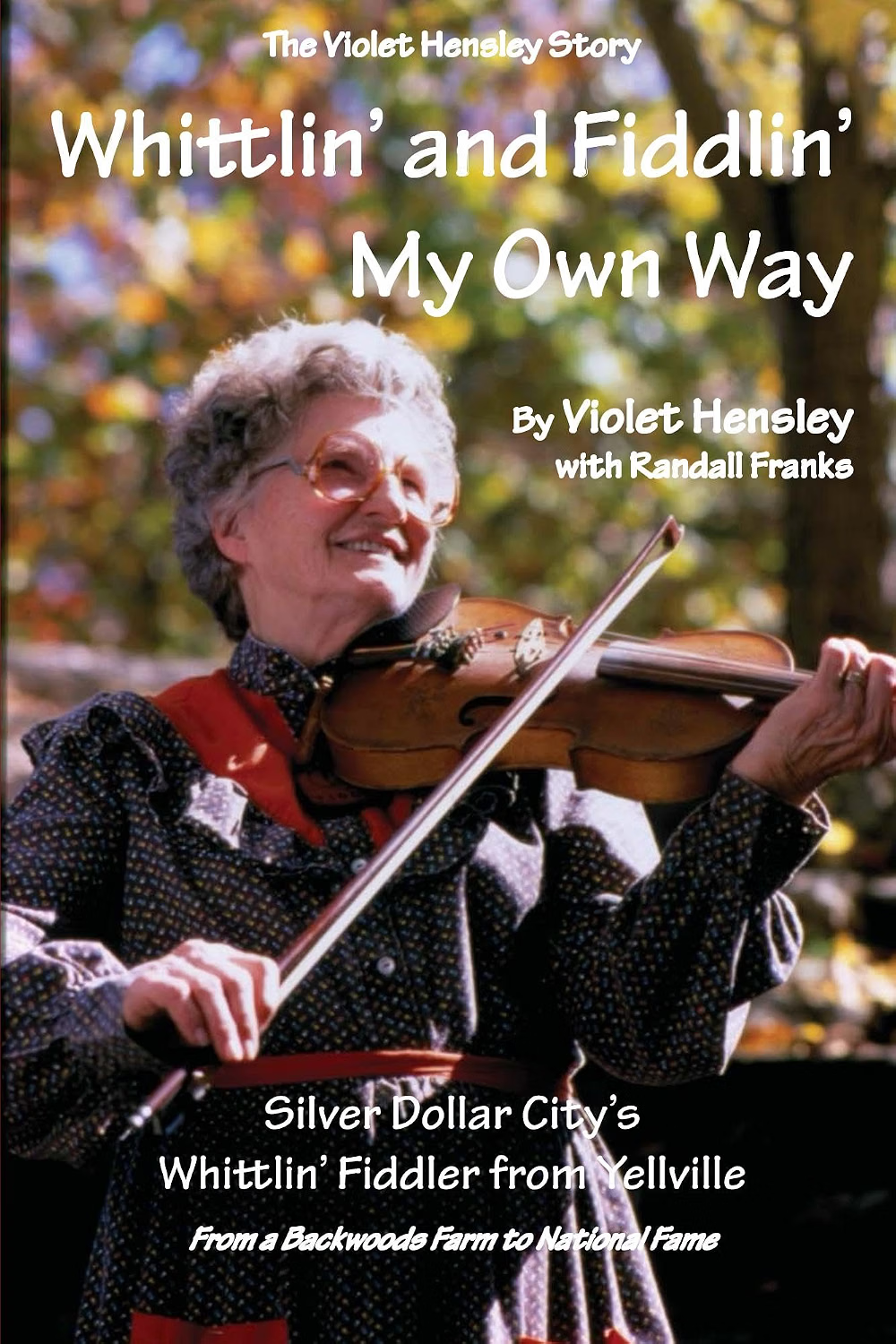
About the book:
“Whittlin’ and Fiddlin’ My Own Way” reflects nearly a century of experiences through the eyes of Silver Dollar City personality Violet Hensley. The Arkansas Living Treasure Award winner from Yellville, Arkansas learned to fiddle in 1928 and make fiddles watching her father George W. Brumley in the community of Alamo, Arkansas in 1932.
She raised a family of nine with her late husband Adren Hensley while he moved the family from town to town and state to state. With the advent of the folk music revival, Violet’s blossoming musical and fiddle-making talents, caught the attention of Grammy ® winner Jimmy Driftwood and the owners of Silver Dollar City in Branson, Missouri.
She joined the crafter’s cast at Silver Dollar City in 1967, becoming part of the City’s celebrities who used radio, television, and newspapers to invite visitors to the amusement park.
Sharing her talents in front of millions, she appeared at the Festival of American Folklife and on television shows such as “The Beverly Hillbillies,” “Captain Kangaroo,” and “Live! with Regis and Kathie Lee
Thank you,
Glenda, Charlie and David Cates